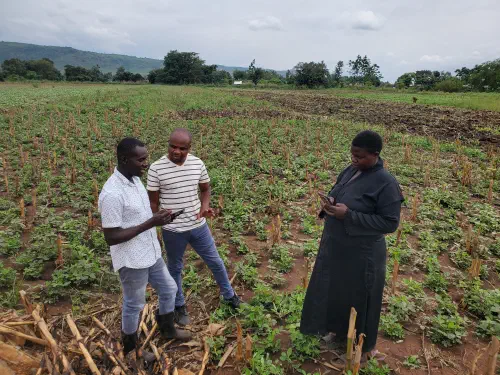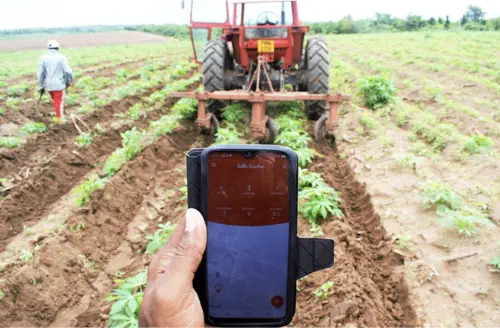


We weighed the harvests of 605 farmers in Kenya and Uganda. Here is what happened when AI advice came with different levels of human support.
One question follows AI advice around the sector: does it work without a person beside the farmer? If not, how much human support does it need?
Our 2025 short rains study gives a sharper answer than we’ve had before. We compared farmers who used Virtual Agronomist (VA) with farmers who did not, then split the VA farmers into groups based on the level of support they received in implementing the recommendations.
The short answer: VA farmers harvested more than non-VA farmers in every crop and country we tested, and the farmers with the most hands-on support harvested more than twice as much.
That’s a big claim, so here’s exactly how we measured it.
How We Ran the Study
During the 2025 short rains, we followed 605 farmers growing maize, sorghum and sunflower. In Kenya, they farmed in Meru and Tharaka Nithi counties. In Uganda, they farmed in Bulambuli and Sironko districts. They fell into three groups:
- Non-VA farmers (214): farmers who did not use VA.
- Lead-farmer-supported VA farmers (197): farmers using VA with standard support from a lead farmer, a trained farmer from their own community.
- Technician-supported VA farmers (194): farmers using VA with intensive support from iSDA consultants who work more closely with our team than lead farmers do.
Villages were chosen by location and kept apart so one group’s advice couldn’t spill into another, and within those villages, farmers were randomly selected for each group.
Then we measured what each farmer harvested using crop cuts.
A crop cut is the most direct way to measure yield. Field staff mark out a small patch of a farmer's crop, harvest everything in it, then dry and weigh the harvest. That weight is then scaled up to a yield per hectare.
We do this because asking farmers how much they harvested is useful, but bag sizes vary and memories fade, while a crop cut measures every field the same way.
In this study, we marked a 10m by 10m square in the middle of each farmer’s plot, took one crop cut per field, and multiplied the weight of the harvest by 100 to get the yield per hectare.
We also asked farmers what they had harvested, and their numbers told a similar story. Finally, to keep the comparison fair, we adjusted the results for crop, country and soil nutrient levels.
What the Scales Said
Lead farmers are the main way VA reaches farmers, so we looked at them first. Farmers using VA with a lead farmer’s support harvested 56% more than farmers who weren’t using it (a yield ratio of 1.56). That held true in all four crop-and-country combinations: maize and sorghum in Kenya, and maize and sunflower in Uganda.
Farmers supported by iSDA technicians went further: 2.29 times the harvest of non-VA farmers, and about 1.5 times that of the lead-farmer group.
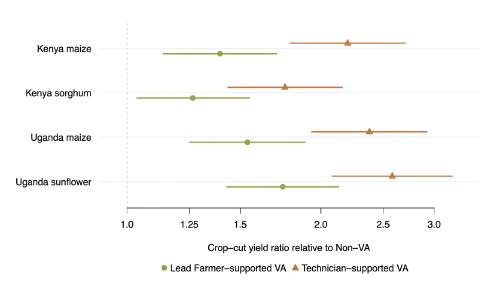
Each dot shows how a group's average yield compares with non-VA farmers (1.0 means the same).
Kenya's weather service described November 2025, normally the peak of the short rains, as unusually dry across much of the country, and Meru, one of our study counties, had received less than a third of its usual rainfall by the 28th. In Uganda, the short rains started late and were below average in most of the country, but when heavy rain did come, it brought flooding in the east in early November. Even so, VA farmers out-harvested non-VA farmers in all four crop-and-country combinations.
The Answer Isn’t Just ‘More Fertiliser’
It’s fair to assume extra fertiliser was the difference-maker. VA farmers did use more nitrogen: about 28 kg per hectare among non-VA farmers, 47 kg per hectare with lead-farmer support and 54 kg per hectare with technician support. So fertiliser helps, but especially when a farmer knows what their own plot needs and applies it with confidence, which is what VA’s plot-specific advice gives them.
However, our early analysis suggests nitrogen alone didn’t explain the gains, especially among technician-supported farmers. It points to better management across the season: better weeding, better crop protection, and advice applied more accurately and on time.
In other words, advice only pays when it is followed properly and on time. That is where hands-on support appears to make the difference.
Ultimately, Money Sings the Same Tune
A bigger harvest only helps if the farmer ends up with more money. Here is what they earned.
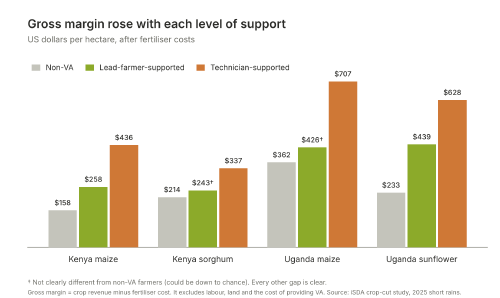
Mean gross margin based on crop-cut yields and fertiliser costs
These are gross margins: what a farmer earns from the crop after paying for fertiliser. They leave out labour, land and the cost of providing VA, so they aren’t profit. But they do show whether the extra fertiliser paid its way.
Where support was strongest, it did. Technician-supported farmers consistently earned more than non-VA farmers in all four combinations. Take sunflower in Uganda: about $233 per hectare without VA, $439 with a lead farmer’s support and $628 with a technician’s. Lead-farmer support also brought a clear gain in Kenya maize. In Kenya sorghum and Uganda maize, margins were higher on average, but the gap was small enough that it could have been chance.
Kenya’s margins are lower overall because its farmers spent more on fertiliser and harvested less. Even then, the gains were large: Kenya maize margins rose from $158 to $436 per hectare with technician support.
More Support, Further Reach
Overall, the study points in one direction: the more hands-on the support, the better the outcomes for farmers. But iSDA’s team can’t visit every farm. That’s why VA is built around lead farmers, who bring agronomic advice and support to their neighbours. The study also suggests that the quality of that support matters: the farmers helped by the people who know VA best harvested the most. So we keep investing in lead farmers’ training and in keeping their knowledge current.
The same logic applies to extension workers. In many places, one extension worker serves thousands of farmers. Kenya’s extension policy notes that the ratio has not improved and sets a target of one officer per 600 farmers by 2029. In Uganda, government figures put the ratio at one officer per 1,800 farmers, against a recommended one per 500. Extension workers need regular knowledge updates and good tools to reach further. VA is built to support that work, not replace it. It gives each farmer advice for their own plot, and it gives the extension worker a nutrient plan they can check, adapt, and explain on the spot.
So how much human support does AI advice need? In this study, more support brought better results at every step, which is why we build VA to help that support reach further.
iSDA builds AI-powered advisory tools for smallholder farmers across sub-Saharan Africa. Its flagship product, Virtual Agronomist, delivers personalised, science-backed recommendations via WhatsApp across 8 countries, with over 1 million plots registered to date. To collaborate or learn more, contact us at info@isda-africa.com.