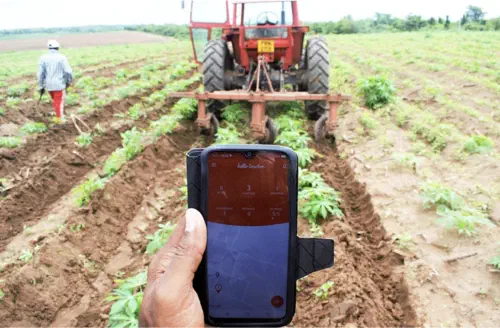


For most of his farming life, an elderly Ugandan farmer did what the farmers around him did: he applied fertiliser when he could afford it, guessed at the amounts, and watched his neighbours' harvests to figure out whether he was doing things right. Some seasons were better than others, but he didn't know why.
Then Monalisa Mutesi, iSDA's Country Team Leader in Uganda, walked into a community training session he had been invited to attend. By the time it ended, he turned to her and said something she has not forgotten: "We have been farming in the dark, but with this new technology, our eyes have been opened."
He had not yet used Virtual Agronomist, but that was his response before a single recommendation had reached his plot.
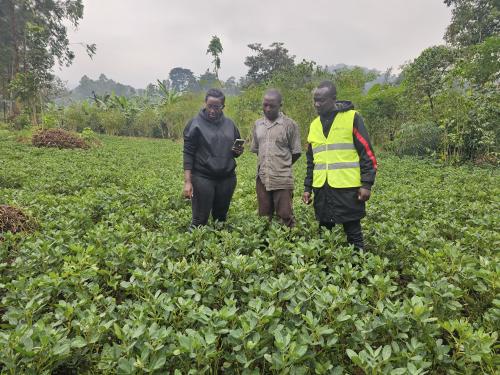
That moment captures what iSDA is building towards. Not just better yields, but a farming life where every decision — what to plant, when to apply, how much to use — is grounded in real information about real soil, not a passed-down habit or a neighbour’s guess.
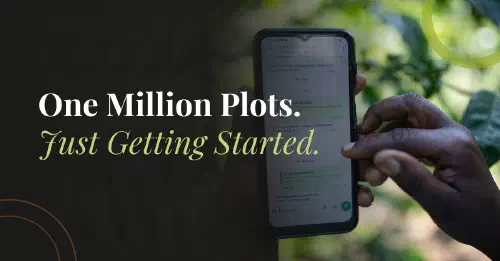
iSDA, supported by the Gates Foundation, has built Virtual Agronomist to do exactly that. In under two years, our Virtual Agronomist has been used by farmers on over 1.3 million plots across 8 African countries. In the first quarter of 2026 alone, we nearly doubled the total plots reached across all of the previous year, with individually tailored nutrient management plans delivered to more than 98% of them.
That pace did not happen by accident. And it did not happen because the technology worked perfectly from day one.
Nearly
2×
In Q1 2026 alone, iSDA nearly doubled the total number of plots it had reached across all of the previous year, with nutrient management plans delivered to more than 98% of them.
The Gap Virtual Agronomist Was Built to Close
Agricultural extension has long been proven to work. When a trained agronomist visits a farm in person and the farmer is able to act on their advice, yields can rise by 50 to 100%. The problem is cost: between $30 and $60 per farmer per year. Across sub-Saharan Africa, where extension ratios run as high as one agent to every 10,000 farmers, that cost makes anything close to full coverage impossible. Billions have been spent, but the yield gap has barely moved.
Our premise was not to replace agronomists. It was to take what agronomists know and build a system that could deliver it to any farmer, at any location, at a cost that actually works at scale.
$1.15
Our total delivery cost per plot, per season. Traditional in-person extension runs $30 to $60 per farmer.
What Virtual Agronomist Is
Virtual Agronomist is not a general-purpose AI that happens to know about farming. It uses a large language model as the conversational layer on top of deterministic agronomic models, which means the underlying recommendations are scientifically grounded and consistent rather than generated afresh each time. Every recommendation is calibrated to a farmer’s specific plot location, soil nutrient status, crop type, and target yield.
That precision starts with iSDAsoil, one of Africa’s most detailed soil datasets, mapped at 30-metre resolution across the continent. When a farmer registers a plot, the soil data is already there. The system knows the land before the farmer types a single question.
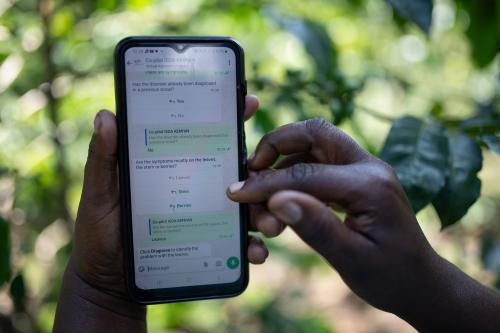
Virtual Agronomist is delivered via WhatsApp, with no app to download and no new platform to learn. Interestingly, that decision came from a single conversation. Abigail Wairimu, one of our software engineers, had been talking through logistics with Makena, a young farmer and entrepreneur in Kenya who bought produce from other farmers and sold it on to local traders. Makena was, in many ways, a lead farmer before we even had a name for the role: someone other farmers already trusted and turned to. She told Abigail that 70% of her coordination with other farmers already happened over WhatsApp. From then, we cut out the custom app we had been building and moved to the channel farmers were already using.
Across rural sub-Saharan Africa, smartphone ownership among smallholders remains well below 50% in most markets, so for farmers without smartphones, lead farmers bridge the gap. These are community farmers with better access to digital tools and networks, trained to carry VA’s recommendations to their neighbours. It is this combination of precise technology and human trust that makes both the reach and the cost achievable.
By the Numbers
What We Learnt Along the Way
Our assumption at launch was that the main challenge would be technical: get the models right, optimise for low bandwidth, improve the interface. To our surprise, that assumption did not survive long.
“The technology is not the main concern,” says Bruce Kisitu, iSDA’s Director of Operations. “The issue is getting it in the hands of the users.” Network instability, plot registration complexity, translation friction, digital literacy: these were the real friction points.
Soon we realised that scaling fast requires engineering resilience we hadn’t fully anticipated. Matt Miller, our Director of Engineering, describes watching registrations and nutrient plans “increase by hundreds” in real time, in a way that quickly shifted the team’s focus from refining the product to keeping the infrastructure standing.
What has kept adoption growing, even where recommendations sometimes challenge years of habit, is something simpler than any feature update. As Bruce often puts it: farmers trust the change they can see from the road. A neighbouring field that is visibly doing better is the most persuasive thing iSDA has. All demos, in a sense, are done by the roadside.
“Remarkably, among all the messiness of delivering advice to farmers via AI, we generally see impact results in line with what has previously been achieved only with in-person advisory.”
Jamie Collinson, CEO, iSDA
For Jamie Collinson, the operational challenges are a reminder of what the plots are actually producing. Across cohorts, our farmers have seen an average 60% yield increase. In Uganda’s maize cohort specifically, that figure was 66% — 1.8 tonnes per hectare. 48% of VA users achieved at least 4 tonnes per hectare, compared with 10% using typical practice.
“When I joined iSDA,” Jamie says, “our agronomists told me that an expert could generally help a farmer get 50 to 100% more yield if they were in the field with them. The problem is effective delivery at scale, and AI is demonstrating a real difference there.”
Bruce Kisitu, Director of Operations, iSDA
“Every season has served as a learning cycle. We listened to farmer and field feedback and translated that into improvements in advisory content, user experience, and delivery channels. This ability to iterate quickly has allowed us to remain relevant and effective across different geographies and crops.”
Reflections From the Team
“Building something that’s quick and simple and works for millions of farmers is better than something that’s complex but only works for a few. Things can always be simplified further.”
Matt Miller, Director of Engineering
“The farmers have a hunger for knowledge. Even without smartphones, they are eager to get help to improve their soils.”
Monalisa Mutesi, Country Team Leader, Uganda
“The speed of uptake has been far beyond my wildest expectations.”
Keith Shepherd, Chief Scientist
“Behind the 1M+ plots are farmers making decisions for their fields, harvests and families. This milestone shows that we can reach more farmers, particularly women, with practical advice that might otherwise be difficult or costly to access.”
Monica Cross, Director of Finance
1.3 million plots is a milestone worth marking. But it is also a starting point. We’ve learnt what works and have come to understand where the friction lives, and it’s clear that the farmers still outside our reach outnumber the ones inside it by a long way. That’s exactly what drives what comes next.
What We're Working On Next
The clearest signal of where iSDA goes next has come from the farmers themselves. At scale, the questions they ask tell you what they actually need.
Where can I buy the inputs you recommend? Farmers have asked this repeatedly, and also how to sell their crops once they have grown them. iSDA is working to answer both.
Can I get advice for my livestock too? Most of the farmers iSDA works with keep animals alongside their crops. iSDA is extending Virtual Agronomist to cover the whole farm, not just the plot.
At 1.3 million plots, iSDA can now see something no individual farmer can. Which varieties are performing better or worse in specific locations? This is where data starts working for farmers collectively.
Deeper coverage, more languages. Building on iSDA’s presence across eight countries, the ambition is advice in every language, calibrated to every growing context.
The elderly Ugandan farmer who said we had opened his eyes said it before his first harvest with Virtual Agronomist. With every season we run, every crop we add, and every lead farmer we train, we are confident he will not be the last to feel that way before the harvest results come in.
1.3 million plots. Millions more to go.
About iSDA
iSDA (Innovative Solutions for Decision Agriculture) is an agritech nonprofit giving smallholder farmers across sub-Saharan Africa access to precision agronomic advice via Virtual Agronomist, a WhatsApp-based AI advisory tool backed by iSDAsoil, one of Africa’s most detailed soil datasets.
iSDA currently operates in Kenya and Uganda, with partnership presence across Tanzania, Rwanda, Malawi, Zambia, Ghana, and Nigeria. Virtual Agronomist has registered over 1.3 million plots across 24 crops since launching in 2024. iSDA is funded by the Gates Foundation.
Contact: info@isda-africa.com • Website: isda-africa.com
Latest Stories
Here’s what we've been up to recently.