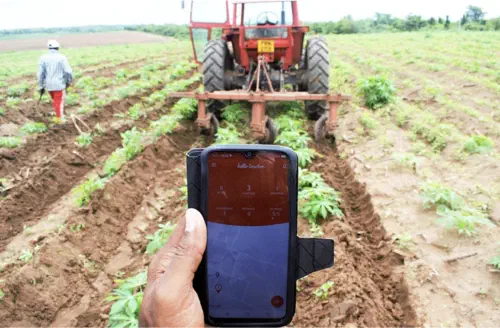


On Earth Day, most of the conversation gravitates toward forests, oceans, and energy. Soil rarely gets its moment — despite the fact that soils provide humanity with 98.8% of its food, and despite being one of the most degraded resources on Earth. Agricultural intensification alone has reduced soil organic carbon stocks by 30–60% over the long term — a loss that affects not just what farms can produce, but how much carbon stays in the ground rather than entering the atmosphere.
This Earth Day, we’re sharing our thinking on a connection that gets too little attention: the link between precision agronomic advice, fertiliser use, and greenhouse gas emissions in African smallholder agriculture.
The Problem with Blanket Recommendations
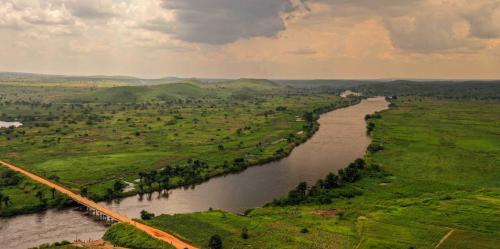
Image by Nathan Carlier via World Food System Center
In most African countries, fertiliser recommendations are typically crop-based and do not take into consideration of soil status or farmers’ management plans. This has resulted in farmers applying the same amount of fertiliser across farms that may have vastly different gradients and management histories. For example, a farmer in the Kenyan highlands and a farmer two valleys over receive the same prescription, even if their soils are fundamentally different.
The evidence suggests this isn’t working. A 2019 meta-analysis across Kenya and sub-Saharan Africa — co-authored by iSDA Chief Scientist Keith Shepherd — found that fertiliser response varied enormously across smallholder maize farms, from negligible to more than 28 times the unfertilised yield. More strikingly, nearly 1 in 5 plots across sub-Saharan Africa showed no yield response to fertiliser application at all.
"The fertiliser was applied. It didn't help the crop. But it didn't disappear either."
Excess nitrogen increases the risk of microbial processes that produce nitrous oxide (N₂O) — a greenhouse gas 273 times more potent than CO₂ and with an atmospheric lifetime of 110–120 years. Unlike CO₂, its warming effect is not seasonal: it persists long after the application that caused it, particularly under favourable soil moisture and temperature conditions. Agricultural nitrogen management is the dominant source of anthropogenic N₂O emissions globally. However, it is mostly an underreported source of N₂O due to generalised emission factors that fail to capture field-level variability. In smallholder systems, where inputs are already stretched and soils poorly characterised, the problem is amplified by the absence of plot-level soil data to guide fertiliser decisions.
The same 2019 study concluded that strategies to improve fertiliser recommendations must include information on soil type and soil properties — texture, pH, organic carbon, and phosphorus availability — at meaningful spatial resolution. Without that data, refinement is guesswork.
What Precision Actually Requires
Image by jcomp via Freepik
iSDAsoil maps soil properties across Africa at 30-metre resolution — the most detailed soil dataset on the continent. It is free, open access, and generates approximately 1 million API calls per year from researchers, governments, and development organisations building on it.
That data layer underpins every recommendation made by the Virtual Agronomist (VA). When a farmer registers a plot via WhatsApp, VA links the recorded GPS coordinates to iSDAsoil, drawing on high-resolution soil data to characterise the field — including nutrient status, pH, soil organic carbon, and key constraints likely to limit yield. Fertiliser recommendations — including type, rate, and timing — are therefore calibrated to the specific plot rather than derived from regional averages.
When farmers apply nutrient rates aligned with their crop’s actual demand, the risk of excess nitrogen in the soil is reduced. This limits the substrate available for microbial processes, thereby lowering the likelihood of N₂O emissions while improving nutrient use efficiency.
"Precision advisory isn't just good for yields. It's a climate intervention."
What We’re Not Yet Claiming
We want to be direct about the limits of what we know.
We have not yet measured the N₂O emissions reduction attributable to VA use. That research still needs doing — and it requires the kind of on-farm emissions measurement infrastructure that is not yet standard in smallholder agriculture in East Africa. We are describing a mechanism, not a measured outcome.
What we can say is this: VA is operating at scale across over 1 million plots in 8 countries, delivering plot-specific recommendations at $1.15 per plot per season. If precision advice reduces unnecessary fertiliser application even modestly across that footprint, the climate implications are significant.
We think that is worth measuring, and would welcome researchers, institutions, and organisations working at the intersection of precision agriculture and greenhouse gas accounting to explore this with us.
The Publications Behind This Argument
The evidence chain in this post draws on work published by iSDA scientists and collaborators. For readers who want to go deeper:
On fertiliser response and nitrogen use efficiency in smallholder systems: Ichami, S.M., Shepherd, K.D., Sila, A.M., Stoorvogel, J.J. & Hoffland, E. (2019). Fertilizer response and nitrogen use efficiency in African smallholder maize farms. Nutrient Cycling in Agroecosystems, 113, 1–19. doi.org/10.1007/s10705-018-9958-y
On spatial diagnosis of yield-limiting nutrients across smallholder landscapes: Ichami, S.M., Karuku, G.N., Sila, A., Ayuke, F.O. & Shepherd, K.D. (2022). Spatial approach for diagnosis of yield-limiting nutrients in smallholder agroecosystem landscape using population-based farm survey data. PLoS ONE, 17(2), e0262754. doi.org/10.1371/journal.pone.0262754
On soil and the intensification of agriculture for global food security: Kopittke, P.M., Menzies, N.W., Wang, P., McKenna, B.A. & Lombi, E. (2019). Soil and the intensification of agriculture for global food security. Environment International, 132, 105078. doi.org/10.1016/j.envint.2019.105078
On continental-scale controls on soil organic carbon in sub-Saharan Africa: von Fromm, S.F., Hoyt, A.M., Lange, M., Acquah, G.E., Shepherd, K.D. et al. (2021). Continental-scale controls on soil organic carbon across sub-Saharan Africa. SOIL, 7, 305–332. doi.org/10.5194/soil-7-305-2021
On iSDAsoil — the foundational soil data layer: Hengl, T., Miller, M.A.E., Križan, J., Shepherd, K., Sila, A. et al. (2021). African soil properties and nutrients mapped at 30 m spatial resolution using two-scale ensemble machine learning. Scientific Reports, 11, 6130. doi.org/10.1038/s41598-021-85639-y
On the Virtual Agronomist — the AI advisory system: Shepherd, K.D., Miller, M.A.E., Kisitu, B., Miles, B.G. et al. (2025). Virtual Agronomist — an AI-assisted chatbot for guiding crop management decisions of smallholder farmers in Africa. CABI agriRxiv. doi.org/10.31220/agriRxiv.2025.00332
On agricultural nitrogen management and global N₂O emissions: Reay, D.S., Davidson, E.A., Smith, K.A., Smith, P., Melillo, J.M., Dentener, F. & Crutzen, P.J. (2012). Global agriculture and nitrous oxide emissions. Nature Climate Change, 2, 410–416. doi.org/10.1038/nclimate1458
On global warming potentials (N₂O): US Environmental Protection Agency. Understanding Global Warming Potentials. epa.gov/ghgemissions/understanding-global-warming-potentials
iSDA builds AI-powered agronomic advisory tools for smallholder farmers in sub-Saharan Africa. The Virtual Agronomist is delivered via WhatsApp, backed by iSDAsoil, and operational across in 8 countries. To collaborate on emissions research or explore our soil data, contact us at info@isda-africa.com.